
DC Product Liability Attorney: How to Get Legal Help
Quick Summary
Product liability law holds manufacturers, distributors, and sellers responsible when a defective product causes injury. In D.C., start by getting medical care, preserving the product exactly as it is, and keeping all packaging and receipts. Then consult a product liability attorney before anyone repairs, discards, or returns the item.
- Preserve the product unrepaired, uncleaned, and undisassembled, and keep all packaging and receipts.
- Get medical care first and keep copies of records, imaging, and billing statements.
- Do not agree to a manufacturer inspection on your own; coordinate it through counsel under a documented protocol.
- Do not post about the incident online, since statements can be used against you.
- Ask any attorney how they staff investigations and what their realistic timeline looks like.
Table of Contents
- What Product Liability Means and Who Can Be Held Responsible
- Types of Product Defects: Design, Manufacturing, and Warning Failures
- What to Do After a Defective Product Injures You
- How to Prove a Product Liability Case in D.C.
- Booking a Product Liability Lawyer Consultation to Protect Your Claim
- Frequently Asked Questions
What Product Liability Means and Who Can Be Held Responsible
Last Updated: November 14, 2026
Product liability is the area of law that holds manufacturers, distributors, and sellers responsible when a defective product causes injury. If a faulty space heater, a dangerous car seat, or a contaminated food item hurts you, product liability law is the framework that determines who pays. (Source: legal standards for negligence)
Product liability claims generally rest on negligence, strict liability, or breach of warranty. Under strict liability, you may not need to prove that the company was careless. You generally need to show that the product was defective and that the defect caused your harm. Negligence claims focus on whether a company failed to exercise reasonable care in design, production, or warnings.
Liability can extend across the entire product supply chain. Potentially responsible parties often include:
- The manufacturer that designed or assembled the product
- Component part makers whose materials or parts were defective
- Distributors and wholesalers that moved the product to market
- Retailers and sellers that sold the product to you
Identifying the right defendants matters. A retailer may be liable even when the manufacturer is overseas, and multiple parties can share responsibility for the same injury.
Types of Product Defects: Design, Manufacturing, and Warning Failures
Product defects fall into three main categories, and each requires a different type of proof. Knowing which category applies to your injury shapes the entire claim.
Design defects exist when the product is dangerous even though it was built exactly as intended. The flaw is in the blueprint itself. An example is a power tool that lacks a low-cost safety guard that competing models include. Plaintiffs often argue that a safer, feasible alternative design was available.
Manufacturing defects occur when a single unit departs from the intended design. The same product line may work perfectly for most buyers, while one item has a cracked weld, a contaminated batch, or a missing component. These cases often depend on comparing the defective unit against the manufacturer’s specifications.
Warning defects involve inadequate instructions or labels. A product may be safe when used correctly but fail to warn about foreseeable risks. Failure to warn claims are common with medications, chemicals, and household appliances.
Manufacturing and design claims are sometimes confused. A single defective unit may point to a manufacturing problem, while a dangerous product line may point to a design problem.
What to Do After a Defective Product Injures You
Your actions in the first days and weeks after an injury can determine whether a claim survives. The product itself is often the single most important piece of evidence, and it is easy to destroy without meaning to.
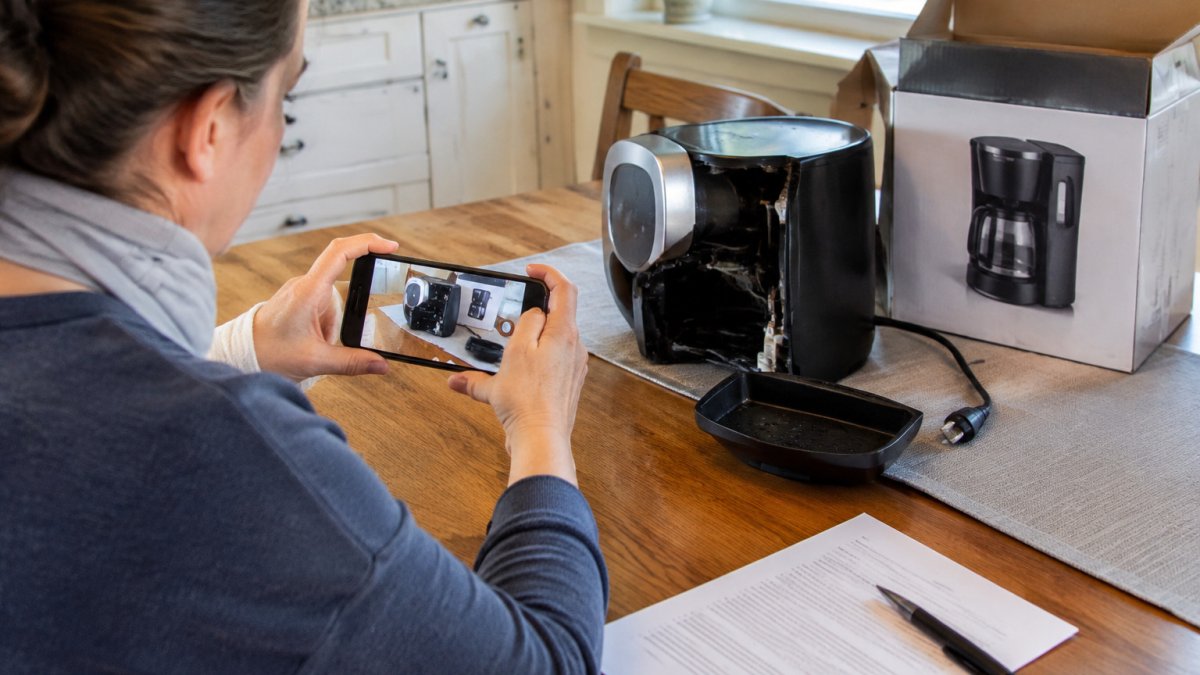
1. Get medical care first, and keep the records. Treatment creates the documented link between the product and your injuries. Ask for copies of imaging, discharge instructions, and billing statements. A gap in treatment is one of the first things a defense lawyer will point to.
2. Preserve the product exactly as it is. Do not repair it, clean it, disassemble it, or run your own tests. Do not throw it away, even if it looks worthless or is broken beyond recognition.
3. Keep everything that came with it. Packaging, inserts, manuals, warning labels, registration cards, receipts, order confirmations, and credit card statements all help establish the model number, the purchase date, and the warnings that were, or were not, provided. Photograph the packaging before you open or discard anything.
4. Document the scene and the injury. Take dated photographs from multiple angles: the product, the packaging, the labels, the injury itself, and the environment where the incident happened. If the product failed during use, photograph it in the position you found it before moving it.
5. Write a contemporaneous account. Record what happened, in your own words, while your memory is fresh. List every witness, their contact information, and what they saw. Save text messages, emails, and chat logs about the incident.
6. Track every expense. Keep medical bills, prescription receipts, repair or replacement costs, and records of missed work. A running log with dates and amounts is more useful than a shoebox of receipts.
7. Do not post about the incident online. Statements on social media, reviews, or forums can be used against you, and deleting them later can create its own problems. Assume anything you post is discoverable.
8. Coordinate any inspection through counsel. If the manufacturer or seller asks to examine or test the product, do not agree on your own.
Watch out: repairing a product to “see what went wrong” or discarding packaging as trash are the two most common ways people unintentionally weaken an otherwise strong claim.
Realistic timelines. Preservation is urgent, but the claim itself moves on a longer clock.
How to Prove a Product Liability Case in D.C.
Proving a product liability claim requires showing that the product was defective, that the defect existed when it left the defendant’s control, and that the defect caused your injury. Each element carries its own evidence burden, and the way a case is investigated often determines which theories remain viable.
The elements in practice. For a design defect, you generally need to show that a safer, feasible alternative design existed and that the product’s risks outweighed its benefits. For a manufacturing defect, you typically compare the unit against the manufacturer’s specifications and against other units from the same line. For a warning defect, you focus on whether the risk was foreseeable and whether the warning was adequate.
Where the evidence comes from.
- The physical product, inspected and tested by a qualified engineer or laboratory under a documented protocol
- Medical records and treating-physician opinions linking the injury to the defect
- Manufacturer documents, design files, internal communications, complaint logs, and quality-control records, obtained through discovery
- Prior complaints and litigation involving the same product or model
- Government safety records, including recall notices published by the Consumer Product Safety Commission at cpsc.gov and, for vehicles and equipment, the National Highway Traffic Safety Administration at nhtsa.gov
How an attorney actually investigates. A typical investigation starts with an intake interview and a review of your records, then moves to securing the product and arranging a joint inspection with the manufacturer or seller present. Your expert examines the product, photographs it, and prepares a report.
Recalls and regulatory records. A recall can be powerful evidence that the defendant knew or should have known about a danger, and a pattern of complaints filed with a federal agency can support a punitive-damages theory.
The claim process and realistic timelines. Most matters follow a recognizable arc: initial evaluation, investigation and expert review, pre-suit demand and negotiation, filing and service if negotiation fails, discovery, dispositive motions, and trial or settlement. Each stage has its own timing pressures. Investigation and expert review commonly take several months; negotiation can add months; and litigation often extends the matter well beyond a year.
Deadlines. Limitations periods apply, and they can be shorter than plaintiffs expect. Because the rules depend on the specific facts and the parties involved, confirm the deadline with counsel rather than relying on a general rule of thumb.
Watch out: waiting to consult an attorney until after a product has been repaired, discarded, or returned to the seller can eliminate the best evidence in the case before anyone has had a chance to inspect it.
The table below summarises the main proof sources and recall-record considerations an attorney weighs when investigating a product claim.
| Evidence source | What it shows | Caution |
|---|---|---|
| Physical product | Defect, tested by a qualified engineer | Inspect under a documented protocol |
| Medical records | Link between injury and defect | Treatment gaps are scrutinised |
| Manufacturer documents | Design files, complaints, QC records | Obtained through discovery |
| Prior complaints and suits | Pattern of similar failures | Must involve same product or model |
| CPSC and NHTSA recall notices | Possible knowledge of danger | Recall alone does not prove causation |
Booking a Product Liability Lawyer Consultation to Protect Your Claim
If you were injured by a defective product, a consultation is the practical next step. A consultation lets an attorney review your facts, explain the legal options, and identify evidence that needs immediate attention.
When you speak with a lawyer, bring the product if possible, along with receipts, medical records, photos, and a written timeline. Ask how the firm handles investigation, expert retention, and fee arrangements before you decide.
At Law Office of Mohaimina Haque, PLLC, we are a Washington, DC practice led by a global CEO and attorney, Mohaimina “Mina” Haque. Contact us to schedule a consultation and learn how we can help you protect your claim.
BUTTON: Book Your Product Liability Review
CARD_TITLE: Hurt by a defective product?
CARD_TEXT: Law Office of Mohaimina Haque, PLLC reviews product injury claims in Washington, DC.
Frequently Asked Questions
What should you do after being injured by a defective product?
Stop using the product and keep it in the condition it was in when the injury happened. Photograph the product, packaging, receipts, and the injury itself. Seek medical care and keep every record, since treatment notes often become central evidence. Avoid giving recorded statements to the manufacturer or its insurer before speaking with a product liability attorney. A consultation can clarify what to preserve and which deadlines apply in the District of Columbia.
What evidence should you keep for a product liability claim?
Keep the defective product itself, along with its original packaging, manuals, warning labels, and any replacement parts. Save receipts, order confirmations, and proof of purchase. Preserve medical records, bills, and documentation of lost wages. Write down how the injury happened while your memory is fresh, and collect names of witnesses. Store photos and messages about the product or the incident. Do not repair or discard the item without first discussing it with your attorney.
How can an attorney help with a product liability claim?
A product liability attorney investigates who designed, manufactured, distributed, or sold the product, and whether a design defect, manufacturing defect, or inadequate warning caused your injury. The attorney can retain experts, request records, and evaluate damages such as medical expenses, lost wages, and pain and suffering. An attorney also manages negotiations and filing deadlines.
Can you sue for emotional distress in a product liability case?
Emotional distress damages may be recoverable in some product liability cases when they flow from a physical injury caused by the defective product. Whether they are available depends on the facts of your case and how D.C. courts have applied the governing law. Because the rules are specific, speak with a Washington, D.C. attorney who can evaluate your situation and explain the damages that may apply.





